
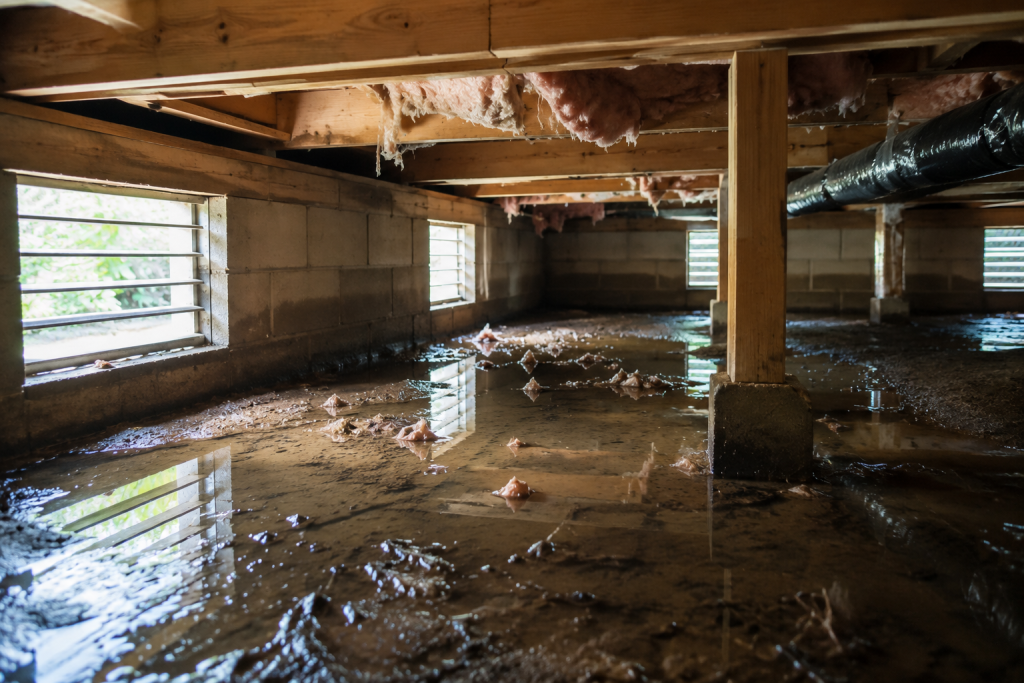
A homeowner in Chesapeake had noticed the musty smell for three summers in a row. Every spring it would ease off, and every July it would come back stronger than before. She had bought two portable dehumidifiers. She had the HVAC serviced. She had replaced the vapor barrier herself with a roll of plastic sheeting from a home improvement store.
The smell came back every time.
When We Crawl Spaces inspected the crawl space, the answer was visible within a few minutes. The plastic sheeting was overlapping but not sealed at the seams. Moisture was moving through the soil and through the block foundation walls and accumulating in the crawl space air. The dehumidifiers were running constantly and pulling moisture out, but the source was being replenished every day by the environment.
She had been treating a symptom. The cause was the crawl space itself.
Why Hampton Roads Is Harder on Crawl Spaces Than Most Places
The coastal environment in Hampton Roads creates crawl space conditions that do not exist in the same way in drier climates. Understanding why helps explain why generic solutions fail here.
Hampton Roads sits at sea level along the Chesapeake Bay and the Atlantic coast. Ambient humidity during summer months regularly exceeds 80 percent. Sandy and loamy soils common to the tidewater region drain slowly after rainfall and hold ground moisture close to the surface. The water table in many parts of Chesapeake, Virginia Beach, and Norfolk is high enough that it rises seasonally.
Crawl spaces in this environment are not just damp. They are under continuous moisture pressure from three directions: the ground below, the walls on the sides, and the humid air that enters through foundation vents. A standard vapor barrier on the floor addresses one of those three sources. Open foundation vents, which were standard practice in older construction and still exist in most homes built before 2009, actively pull the humid outside air in.
Mold grows in crawl spaces when moisture combines with wood and organic material and temperatures stay above 60 degrees Fahrenheit. In Hampton Roads, that condition exists from April through October. The July spike most homeowners notice is not a new problem. It is the seasonal peak of a year-round condition.
Why Band-Aid Fixes Do Not Work Here
Portable dehumidifiers work in the sense that they remove moisture from the air in the space. The problem in an unencapsulated crawl space is that the moisture source is continuous. Running a dehumidifier in an open crawl space in Hampton Roads in July is like bailing a boat without plugging the hole.
Partial vapor barriers fail for the same reason. Moisture migrates through unsealed seams, around the edges, and through any gap between the barrier and the foundation wall. The coverage that looks complete on installation is not complete enough to interrupt the moisture cycle.
Encapsulation addresses all three moisture sources in a coordinated system. A heavy-duty sealed liner covers the ground and runs up the foundation walls, bonded at the seams and at the perimeter. Foundation vents are sealed or converted. A properly sized dedicated crawl space dehumidifier, which is built to operate in a sealed environment rather than an open one, manages residual humidity. Together, the system creates a controlled environment that stays below the humidity threshold where mold develops.
The distinction between a sealed crawl space system and a dehumidifier in an unsealed space is the difference between solving the problem and managing the symptom.
What We Crawl Spaces Brings to the Work
We Crawl Spaces is a licensed DPOR Class “A” contractor in Hampton Roads. The DPOR Class “A” license matters specifically in this region because many crawl space and encapsulation contractors are not licensed to perform structural work. When moisture damage has affected floor joists or foundation walls, which it often has by the time a homeowner calls about a persistent odor, a contractor without structural licensure cannot legally address it.
We Crawl Spaces handles structural repair and environmental remediation under one contract. Foundation jacks, floor joist repair, and wall stabilization are performed by the same team that encapsulates the space and installs the dehumidifier. There is no gap between what the moisture contractor addresses and what the structural contractor needs to come back to fix.
The company serves homeowners in Chesapeake, Virginia Beach, Norfolk, Suffolk, Newport News, and Hampton.
A Concrete Next Step
If the musty smell in your Hampton Roads home has been coming back every summer despite what you have tried, the solution is a free crawl space inspection with We Crawl Spaces. We identify root causes, not symptoms, and provide a clear assessment of what the space requires.